On this page
What is in a BPC-157 and TB-500 Wolverine blend?
“Wolverine” describes BPC-157 paired with TB-500. The featured vial and pen contain equal ingredient weights. That makes the label straightforward once you distinguish the total blend from the amount of each peptide.
The 20 mg vial contains 10 mg of each ingredient. The 40 mg pen contains 20 mg of each in 3 mL. Neither label means that the full stated mass is BPC-157 alone.
A fixed blend keeps that 1:1 ratio in every portion. Separate ingredient vials can be measured on different schedules, which is why an account using them may not translate to a blended pen. For single-ingredient quantities, use the BPC-157 dosage guide.
Wolverine products: the 20 mg vial and 40 mg pen
Compare the amount of each ingredient, the total contents and the preparation required.
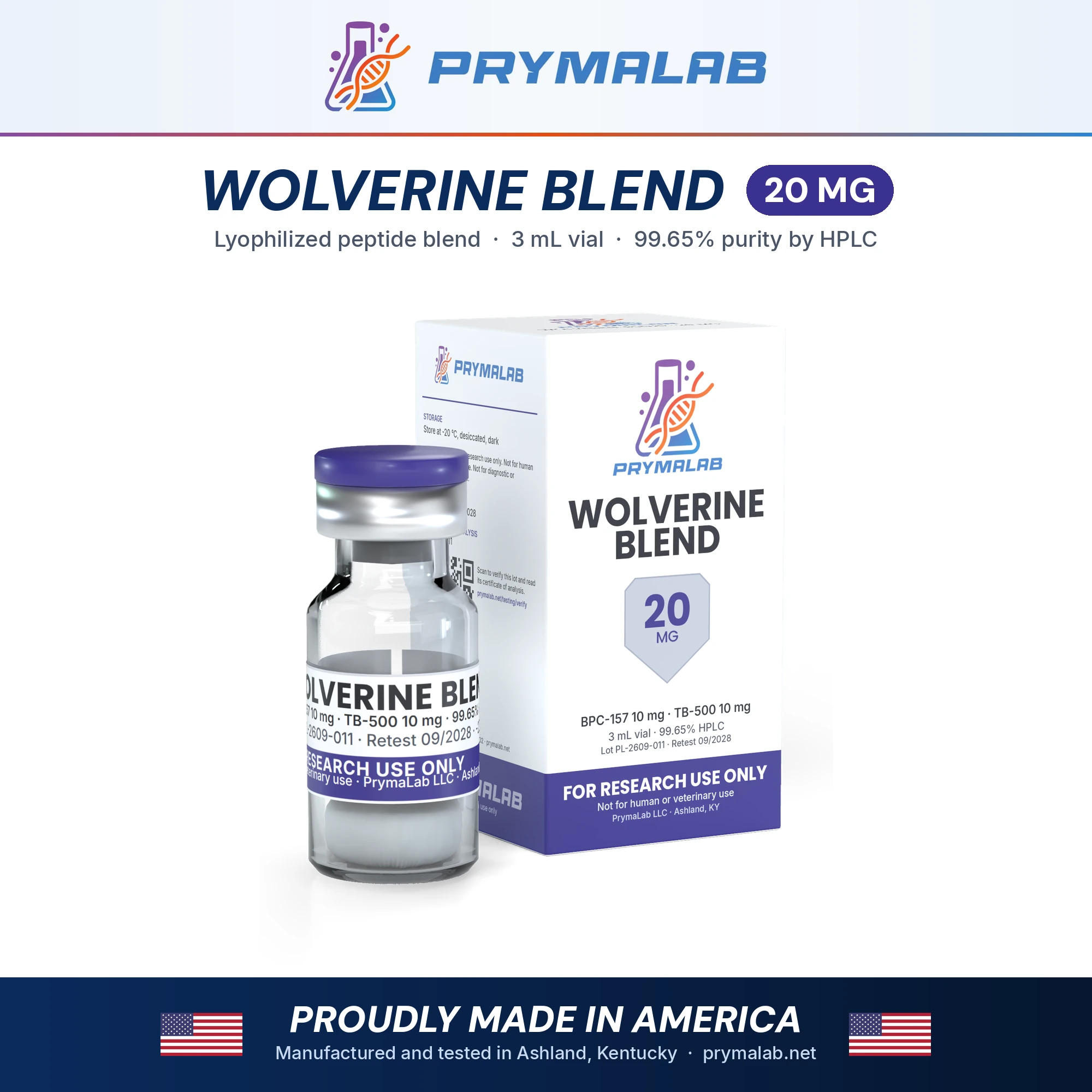
Wolverine 20 mg Vial
A freeze-dried, equal-weight blend with an original vial-batch certificate.
- BPC-157
- 10 mg
- TB-500
- 10 mg
- Combined quantity
- 20 mg
- Preparation
- Reconstitution required
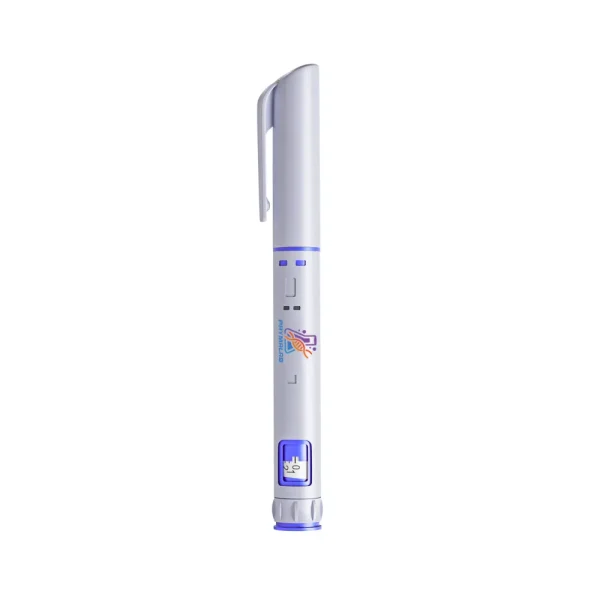
Wolverine 40 mg Pen
The same 1:1 ingredient ratio in a prefilled liquid autoinjector format.
- BPC-157
- 20 mg
- TB-500
- 20 mg
- Total / liquid volume
- 40 mg / 3 mL
- Combined concentration
- 13.33 mg/mL
Product links open the dedicated Wolverine website. The vial certificate applies to its stated powder batch.
Does adding TB-500 improve the results of BPC-157?
A human advantage for the combination has not been established. People describe less discomfort and better exercise tolerance, but the research does not yet show that adding a second peptide reliably speeds recovery.
| Evidence | What researchers observed | What it can tell you |
|---|---|---|
| Small human knee series | Three of four people given BPC-157 with thymosin beta-4 reported pain improvement after injections into the joint.1 | An early clinical observation, without randomized groups or a standardized function score. It does not test the featured blend. |
| 2026 Achilles repair experiment | In 32 rats, TB-500 alone improved maximum load to failure versus control. The combination did not add benefit over individual treatment.2 | Direct combination research after tendon transection and repair, with daily intraperitoneal treatment for 30 days. Only four animals per group contributed to each mechanical or tissue assessment. |
| BPC-157 tendon-cell work | Greater outgrowth from rat tendon tissue, cell migration and survival under oxidative stress.3 | A potential repair mechanism for BPC-157, without a clinical comparison against Wolverine. |
The rat study did not find a statistically significant force-test improvement for BPC-157 alone. Its findings help define the research question; they do not supply a human treatment ranking. The knee series is also too small and uncontrolled to rank the two approaches.21
Is 500 mcg of blend the same as 500 mcg of each peptide?
No. In a 1:1 product, each ingredient accounts for half the combined weight. “500 mcg each” adds up to 1,000 mcg, or 1 mg, of total blend. That distinction doubles the quantity when the wording is misread.
| Stated combined amount | BPC-157 content | TB-500 content |
|---|---|---|
| 500 mcg | 250 mcg | 250 mcg |
| 1 mg / 1,000 mcg | 500 mcg | 500 mcg |
| 2 mg / 2,000 mcg | 1 mg | 1 mg |
Ratio and concentration answer separate questions. Two 1:1 products can contain different milligrams per milliliter, depending on the total mass and final liquid volume. A chart headed only “Wolverine units” is incomplete without both.
Which BPC-157 and TB-500 schedules appear in original accounts?
The accounts below include a fixed daily blend, a split daily blend and a separate-ingredient routine. They are reports of experimental use, not established treatment regimens. Weekly and course totals are arithmetic applied to the stated amounts.
| Account | Reported amount | Calculated weekly total | Time described |
|---|---|---|---|
| Once-daily equal blend4 | 500 mcg BPC-157 + 500 mcg TB-500 daily | 3.5 mg each; 7 mg combined | 4 weeks: 14 mg each, 28 mg combined |
| Morning and evening blend5 | 500 mcg combined twice daily; ratio unstated | 7 mg combined; ingredient totals unknown | 4-week initial update: 28 mg combined |
| Two separately measured ingredients6 | BPC-157 500 mcg twice daily; TB-500 2 mg twice weekly | 7 mg BPC-157 + 4 mg TB-500; 11 mg combined | About 3 months; exact course total unspecified |
The first two descriptions both total 1 mg of combined material per day. Only the first gives enough information to calculate the amount of each ingredient.
For comparison, exactly 12 weeks of the separate-ingredient routine would total 84 mg BPC-157 plus 48 mg TB-500, or 132 mg combined. This is a worked calculation, not the exact recovered total from an “about three months” account. Its unequal ingredient totals cannot be reproduced with a fixed 1:1 blend.
No weight-based schedule, safe maximum or injury-specific effective amount can be established from these individual experiences.
How do four-, six-, eight- and twelve-week quantities compare?
Public accounts describe four weeks, eight weeks and roughly three months. In one eight-week shoulder account, the first improvement appeared around two and a half weeks while rehabilitation continued.476 These are observation periods, not evidence of an optimal cycle.
| Period | Total blend | Each peptide in a 1:1 blend | 20 mg vials | 40 mg pens |
|---|---|---|---|---|
| 4 weeks / 28 days | 28 mg | 14 mg | 2 | 1 |
| 6 weeks / 42 days | 42 mg | 21 mg | 3 | 2 |
| 8 weeks / 56 days | 56 mg | 28 mg | 3 | 2 |
| 12 weeks / 84 days | 84 mg | 42 mg | 5 | 3 |
Package counts round up and assume no losses. Holding enough material for a period does not mean a container remains suitable for that long after mixing or opening. Stability and discard dates require separate product documentation.
At an unchanged daily amount, doubling duration doubles the total exposure and quantity used. The accounts do not establish that the extra weeks improve recovery, or that a particular break makes repeated courses safe.
What happened in the shoulder and knee Wolverine accounts?
The following accounts were selected for reported improvement. They describe symptoms and activities, and are not verified customer testimonials for these products.
Pressing became more comfortable
One writer had experienced shoulder difficulty for more than six months. A four-week blend course coincided with substantial improvement; a later update described pain-free pressing a few months afterward. The original problem had not been diagnosed, so the post cannot establish repair of a specific injured structure.4
Movement improved before recovery was complete
Following recurrent shoulder subluxations, another author noticed improvement at about two and a half weeks. Strength and proprioception work continued during the eight-week course. Movement became easier and less painful, but the final account still described incomplete recovery.7
Symptoms eased while the scan still showed a tear
An account using separate BPC-157 and TB-500 described less pain, clicking and swelling, more comfortable gym sessions and disappearance of a Baker's cyst. The author had a long rehabilitation history. Follow-up MRI reportedly still showed meniscal tearing.6
The last case makes a useful distinction: symptom improvement and structural repair are not interchangeable. These reports also cannot separate the peptides' contribution from exercise, rehabilitation or time. Additional accounts appear in the dedicated Wolverine results guide.
What does a 20 mg Wolverine vial contain after adding diluent?
At a final solution volume of 2 mL, a 20 mg equal blend contains 10 mg/mL combined, with 5 mg/mL of each peptide. Changing the final volume changes the concentration; it does not change the total labeled mass.
What do the laboratory preparation documents specify?
- Confirm the contents and compatible diluent. Check that the vial is the 10 mg BPC-157 + 10 mg TB-500 powder. Follow its handling documents when selecting diluent. Manufacturer information for bacteriostatic water requires compatibility with the material being dissolved.8
- Set up aseptic handling. Use new sterile transfer equipment, disinfected stoppers and a clean preparation area away from sinks and contamination sources.9
- Record the intended and actual final volume. The table below assumes 2 mL of solution. A different final volume needs a different calculation.
- Add slowly and avoid shaking. The supplied laboratory SDS specifies slow addition along the vial wall without shaking. Allow the material to dissolve, then inspect for unexpected particles or discoloration.118
- Label the preparation and follow its storage instructions. Record date, total mass, volume and concentration. The SDS gives 2–8°C storage after reconstitution, protected from light, with the use period determined by the laboratory. It does not establish a universal post-mixing expiry.11
These are laboratory handling details and concentration examples. They do not establish a validated formulation or protocol for human injection.
| Measured volume | U-100 volume markings | Combined content | BPC-157 + TB-500 |
|---|---|---|---|
| 0.05 mL | 5 units | 500 mcg | 250 mcg + 250 mcg |
| 0.10 mL | 10 units | 1 mg | 500 mcg + 500 mcg |
| 0.20 mL | 20 units | 2 mg | 1 mg + 1 mg |
At a final volume of 3 mL, the 20 mg vial contains about 6.67 mg/mL combined, or 3.33 mg/mL each. The prefilled 40 mg / 3 mL pen has twice that concentration: about 13.33 mg/mL combined, or 6.67 mg/mL each.
BPC-157 + TB-500 blend calculator
Enter both ingredient amounts and the final volume. The amount to convert is the combined blend.
This calculator converts an entered amount; it does not choose a dose. U-100 markings describe volume, not pen clicks. Calculated precision does not establish a device’s measuring precision.
A U-100 scale measures volume, with 100 units equal to 1 mL. A pen's clicks require its own calibration; those markings cannot be substituted. The calculator determines contents at a chosen volume, not a treatment amount.
How do the featured Wolverine vial and pen compare?
The 20 mg powder vial requires preparation for laboratory use and contains 10 mg per ingredient. The 40 mg prefilled pen contains 20 mg per ingredient in 3 mL. The quantity doubles; a vial batch report does not automatically become a finished-pen report.
The original vial certificate is PL-26-00011 for lot PL-2609-011. It reports 99.65% HPLC area purity and is an in-house report for the lyophilized vial lot. This measurement does not establish clinical benefit or certify the finished pen.
Read the original vial certificate
The unchanged two-page document preserves the actual batch and test details.
Wolverine-Peptide.us provides a dedicated overview, with separate information for the blend vial and prefilled autoinjector.
What else should you know about a Wolverine blend?
How many portions are in the 20 mg vial or 40 mg pen?
Ignoring losses, a 20 mg vial contains twenty 1 mg combined portions or forty 500 mcg combined portions. A 40 mg pen contains twice as many. That count does not establish how many days a prepared or opened container remains suitable for use.
Does splitting the daily amount produce a better result?
Is four weeks on and two weeks off an established protocol?
That pattern appears in one contributor's separate-ingredient account. It does not establish a required reset period or the safety of repeated exposure.5
Do reports prove that an injection near an injury works better?
Can I copy the units from a BPC-157-only chart?
No. Recalculate from this product's total mass, ratio and volume. In a 1:1 blend, a portion containing 500 mcg BPC-157 necessarily also contains 500 mcg TB-500.
How do I convert the pen's clicks into micrograms?
You need the verified volume delivered per click. The 40 mg label and 3 mL fill only establish concentration. You must also specify whether the requested amount means combined blend or one ingredient; a U-100 chart cannot provide the device calibration.
Is the featured blend an FDA-approved recovery treatment?
No. FDA's BPC-157 evaluation identifies limited human safety evidence and concerns about immune reactions and peptide impurities. Discuss the actual injury and evidence-based care options with a healthcare professional before considering an experimental combination.10
Original studies, personal reports and handling documents
- Lee & Padgett: intra-articular BPC-157 for knee painRetrospective series; four respondents received BPC-157 with thymosin beta-4.
- Biçer et al.: BPC-157 and TB-500 in rat Achilles-tendon repairFour-group animal experiment; no added combination benefit.
- Chang et al.: tendon outgrowth, cell survival and migrationRat tendon tissue and cell experiments.
- Four-week blend course: shoulder symptoms and follow-upOriginal public personal account.
- Wolverine stack discussion: firsthand schedulesTwo contributors describe a split daily blend and a separate-ingredient cycle.
- Meniscus symptoms: separate ingredients and later imagingSeparate ingredient schedule, symptoms and reported MRI findings.
- Eight-week shoulder account with continued rehabilitationContinued strengthening and proprioception work.
- Bacteriostatic Water for Injection: manufacturer informationCompatibility, visual inspection and product-specific storage instructions; not approval of this blend.
- CDC: preventing unsafe injection practicesClean preparation, aseptic technique and new sterile equipment.
- FDA: BPC-157-related bulk substances evaluationApproval status and limitations of human safety evidence.
- Wolverine blend laboratory safety data sheet: PL-SDS-187Original five-page PDF. Section 7 specifies slow diluent addition, no shaking and laboratory storage conditions.
Ingredient quantities come from the supplied specifications and original vial documents. The personal accounts are unverified and selected for the outcomes described; their schedules are distinguished from calculated examples.