On this page
What is inside the 30 mg BPC-157 spray?
The bottle contains 30 mg of BPC-157, with 150 mcg per spray. It is a premixed liquid supplied in a pump bottle, so there is no powder-reconstitution step.1
The documented carrier is bacteriostatic water with 0.9% benzyl alcohol. That identifies the formulation, not the amount absorbed through the nose.2
| Question | Answer |
|---|---|
| How much BPC-157 is in the bottle? | 30 mg, equal to 30,000 mcg |
| How much is in one spray? | 150 mcg, equal to 0.15 mg |
| Does it need added water? | No. The product is already a liquid. |
| What is the liquid volume? | Actual fill volume and mL per spray have not been confirmed. |
| How many sprays are usable? | No verified usable-delivery count is available. |
You cannot calculate mg/mL from the 30 mg total alone. The missing input is the actual liquid volume; the bottle's appearance does not supply it.
BPC-157 nasal spray: the 30 mg bottle
150 mcg per spray, 30 mg per bottle. Premixed liquid; no reconstitution required.
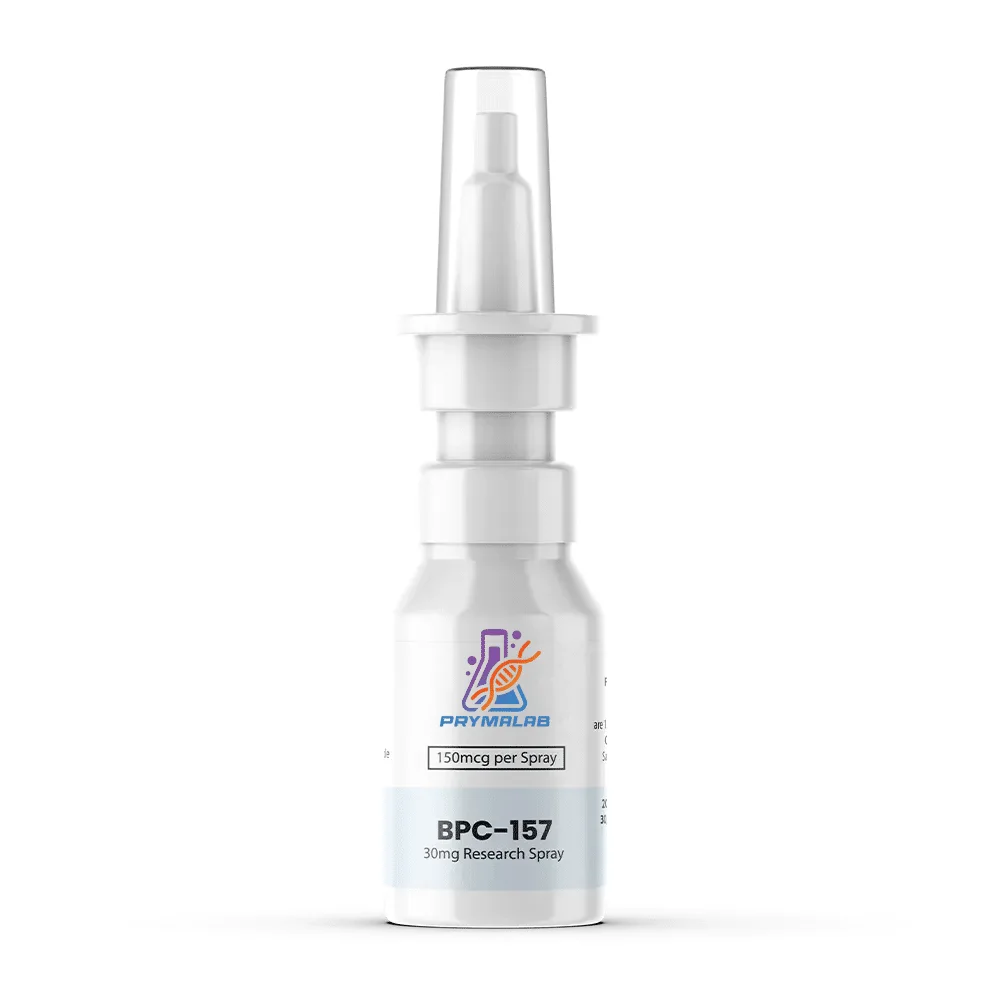
BPC-157 30 mg Spray
150 mcg per spray, 30 mg per bottle. Premixed liquid; no reconstitution required.
- BPC-157 per bottle
- 30 mg
- BPC-157 per spray
- 150 mcg
- Physical form
- Liquid spray
- Preparation
- Premixed
Ordering is not yet available. Package quantities describe label contents, not an absorbed human dose.
How do spray counts translate into micrograms and milligrams?
Multiply the total number of sprays by 150 mcg. Two sprays contain 300 mcg; four contain 600 mcg. Count all actuations together: one spray on each side would count as two in this arithmetic.
| Total sprays per day | Daily quantity | 7 days | 4 weeks | 6 weeks | 8 weeks |
|---|---|---|---|---|---|
| 1 | 150 mcg / 0.15 mg | 1.05 mg | 4.2 mg | 6.3 mg | 8.4 mg |
| 2 | 300 mcg / 0.30 mg | 2.10 mg | 8.4 mg | 12.6 mg | 16.8 mg |
| 4 | 600 mcg / 0.60 mg | 4.20 mg | 16.8 mg | 25.2 mg | 33.6 mg |
For any other quantity example, use sprays per day × days × 150 ÷ 1,000 = milligrams. The four-spray, eight-week example totals 33.6 mg, already more than one 30 mg bottle before allowing for losses.
Why isn't 200 sprays a confirmed bottle count?
Dividing 30,000 mcg by 150 mcg produces 200 nominal spray amounts. It does not demonstrate 200 usable pump deliveries. Priming can consume liquid, some may remain in the container, and output near the end needs testing. FDA quality guidance treats these as properties of the finished spray product.4
Consequently, that division cannot promise a particular number of usable days. It also says nothing about how long the opened liquid remains within specification.
How should the premixed spray be stored?
Keep it at 2–8°C, upright, capped and protected from light. Do not freeze it. These are the product's documented laboratory storage conditions.2 Adding water changes the concentration and invalidates the original 150 mcg-per-spray calculation.
Is there a verified priming or re-priming count?
The available documents provide neither an initial pump count nor a re-priming interval. Those instructions need to come from testing of the actual formulation and pump. Directions for another nasal product cannot supply the missing number.4
What does the handling sheet say?
- Replace the cap and keep the bottle upright between laboratory handling sessions.
- Wipe the nozzle after handling and do not share devices.
- Avoid directing laboratory test sprays toward eyes, faces or other people.
- Discard cloudy or discolored solution; do not freeze the preparation.
The sheet supplies laboratory precautions, not a validated human dosing or administration protocol. It also gives no fixed expiry after opening.2
Has nasal BPC-157 been shown to work in people?
The reviewed evidence does not establish a human nasal dose, absorption percentage or dependable time to benefit. FDA's assessment identifies missing human nasal pharmacokinetic data. A positive finding from a different administration route does not fill that gap.3
| Often-relevant record | What was actually studied | Limit for a nasal-spray claim |
|---|---|---|
| Rat rhinitis experiment, 1997 | Intraperitoneal BPC-157; capsaicin applied in the nose | A nasal inflammation outcome is not evidence of intranasal peptide delivery.5 |
| NCT02637284 / PCO-02 | Registered safety and pharmacokinetic study of oral tablets | The planned product and route were oral, not a nasal pump.6 |
| FDA BPC-157 evaluation | Review of available clinical, formulation and safety information | Missing nasal pharmacokinetics and potential immune-response concerns remain.3 |
See the benefits research guide for the broader gut, tendon, joint and muscle findings. Those findings do not establish that this spray produces the same outcomes or transports BPC-157 directly to the brain.
What do users describe about results and irritation?
A public discussion of BPC-157/TB-500 nasal blends includes a report of easier elbow and knee movement after two to three weeks, followed by running, jumping and cycling. Other comments describe no benefit, dryness or postnasal drip.7
These accounts concern different blend products whose strength and composition were not independently verified. They do not establish results for this BPC-only bottle. Nor can their pump counts be transferred to a 150 mcg spray without knowing the original delivered amounts.
The practical reading is to record both reported improvements and unwanted effects, while keeping the uncertain product identity in view. The discussion cannot provide a success rate, side-effect frequency or typical recovery timeline.
What changes if you choose a different BPC-157 format?
| Product format | Contents | Practical measurement question |
|---|---|---|
| Nasal spray | 30 mg; 150 mcg per spray | How consistently does the finished pump deliver? |
| Capsules | 60 × 500 mcg = 30 mg | What quantity does each finished capsule contain? |
| Powder vial | 10 mg | What concentration results from the final liquid volume? |
| Prefilled pen | 15 mg in 3 mL = 5 mg/mL | What is the verified device volume per setting? |
Equal package totals do not establish equivalent treatment. A 30 mg spray bottle and 30 mg capsule bottle deliver the peptide differently. Read the oral capsule comparison for that route, or the dosage and reconstitution guide for vial concentration and U-100 volume arithmetic.
Which documents should accompany a BPC-157 nasal spray?
Look for the batch identity, total fill volume, amount per spray, pump instructions, storage conditions and after-opening period. Finished-product evidence should address the liquid and dispensing device together, including delivered content and consistency.
For this spray, you can inspect the original bottle label and original safety data sheet. The reviewed product records refer to testing of the peptide used to fill the bottle; no matching finished-spray COA was publicly linked. The separate vial and capsule certificates on this site cannot certify this liquid or its pump.
What should you know before comparing spray options?
Do the quantity tables give a recommended nasal cycle?
No. They convert illustrative spray counts into total peptide quantities. The reviewed human evidence does not validate one, two or four sprays as a treatment schedule or establish a course length.3
Can the SDS be used to call this a 10 mL bottle?
No. Its nominal 10 mL assumption serves a hazard-classification calculation, not confirmation of actual fill volume. Until that volume is verified, neither mg/mL nor mL per spray should be inferred from it.
Does stinging or dryness mean the spray is working?
No. Irritation is not a benefit marker. The public blend discussion includes dryness and postnasal drip, but it cannot establish their cause or frequency. Stop exposure and seek medical advice for persistent irritation.7
Can a frozen, cloudy or discolored solution be restored?
The documented directions say not to freeze it and to discard cloudy or discolored solution. They provide no validated recovery procedure using extra water, shaking or warming.2
Is the nasal format FDA approved or proven safe?
No. FDA identifies insufficient human safety information and potential immune-response concerns for nasal BPC-157. Read the side effects and FDA status guide for the evidence and remaining questions.3
Where can you check the spray documents and studies?
- Original BPC-157 spray label.30 mg total and 150 mcg per spray.
- Original spray safety data sheet, PL-SDS-021.Composition, laboratory handling and storage; revision 1.0.
- FDA — BPC-157 compounding advisory committee briefing.2026 evaluation; nasal pharmacokinetics and safety information.
- FDA — nasal-spray product quality guidance.Priming, re-priming, delivered amounts and pump-performance testing.
- Kalogjera et al. — capsaicin-induced rhinitis in rats.European Archives of Oto-Rhino-Laryngology, 1997; BPC-157 was given intraperitoneally.
- NCT02637284 — PCO-02 safety and pharmacokinetics trial.Registered oral-tablet study, not a nasal study.
- Public discussion of BPC-157/TB-500 nasal sprays.Unverified first-person accounts of other products.