On this page
What do you get in a 500 mcg BPC-157 capsule bottle?
Each capsule contains 500 mcg of BPC-157. A bottle holds 60 capsules, giving 30 mg in total. In milligrams, one capsule is 0.5 mg. Those figures describe the peptide, excluding the capsule shell and filler.1
The formulation uses a hard gelatin shell and microcrystalline cellulose filler. It is not vegan. There is no powder vial to reconstitute and no liquid concentration to calculate; the amount is organized into whole capsules.
The practical question after checking the contents is what oral delivery can achieve. A defined capsule quantity tells you what is in the package. It does not tell you how much reaches the bloodstream or establish a treatment dose.
BPC-157 capsules: 500 mcg per capsule, 60 per bottle
500 mcg per capsule, 60 capsules per bottle, 30 mg total.
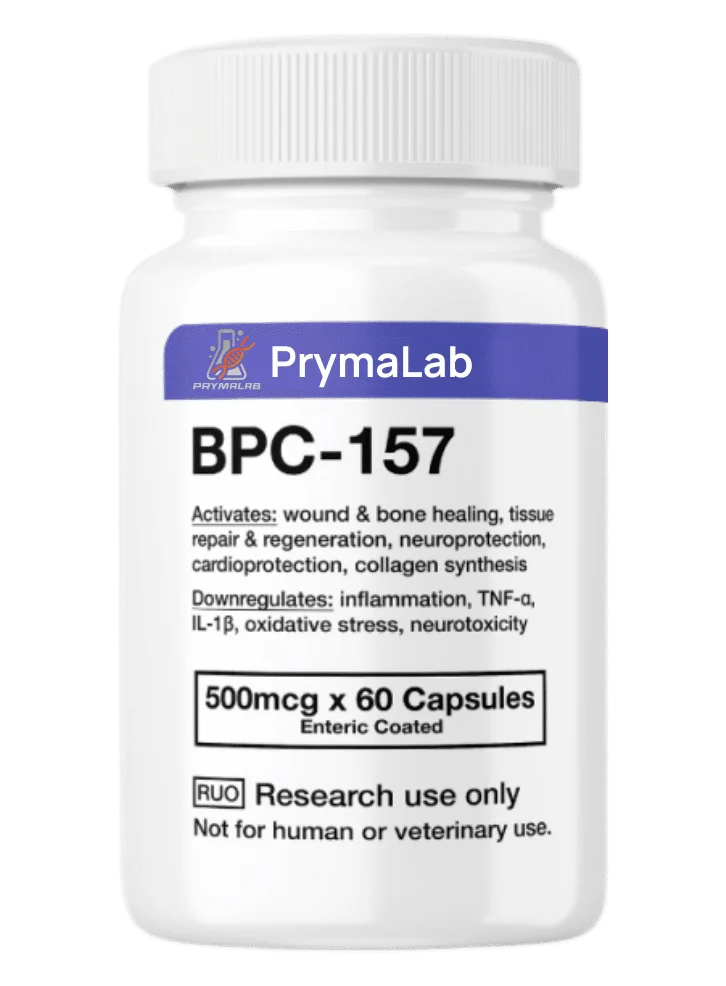
BPC-157 500 mcg Capsules
500 mcg per capsule, 60 capsules per bottle, 30 mg total. Capsule-lot COA included.
- BPC-157 per capsule
- 500 mcg
- Capsules per bottle
- 60
- Total BPC-157
- 30 mg
- Documented lot
- PL-2609-012
Ordering is not yet available. Package quantities describe label contents, not an absorbed human dose.
Can you replace an injection with the same amount in capsules?
There is no validated human conversion between oral and injected BPC-157. Matching the micrograms does not establish matching absorption, exposure or results. Human pharmacokinetic information remains insufficient for that calculation.2
| Comparison | Capsules | Powder vial or pen |
|---|---|---|
| Package quantity | 60 capsules × 500 mcg = 30 mg | 10 mg vial; 15 mg pen in 3 mL |
| Preparation | Whole capsules; no reconstitution | Vial needs preparation; pen contains premixed liquid |
| Quantity calculation | Capsule count × 500 mcg | Concentration × measured liquid volume |
| Can amounts be treated as equivalent? | No established oral-to-injection equivalence is available. | |
Keep the route attached to any result you read. An injected knee-treatment report does not establish what a capsule does for knee pain. An oral account is closer to the capsule question, but its formulation and outcome still need checking.
What supports the claims about gut health and recovery?
A primary rat study tested BPC-157 in chemically induced stomach-ulcer models. Delivery into the stomach reduced ulcer area and supported healing; intramuscular administration produced stronger effects in the same experiment.3 This gives a specific reason for interest in gastrointestinal effects, but it does not establish a human capsule regimen or treatment for IBS.
The experiment used laboratory preparations, not this retail capsule bottle. For tendon, ligament, muscle and joint claims, the benefits and research guide separates the experimental findings by outcome.
Are there published human results for oral BPC-157?
The registered study NCT02637284 describes oral tablets intended for safety and pharmacokinetic testing in healthy volunteers.4 FDA's assessment found no posted results or associated publication. The registration therefore supplies a study plan, not proof of capsule efficacy or a measured absorption rate.2
When have users noticed changes, and what changed?
The useful details in a public experience are the route, time followed, symptom change and other activity during that period. These two accounts concern other products and have no controlled comparison.
Less arm pain during a return to lifting
Capsules · 45 daysOne capsule user described a suspected minor biceps or tendon injury, improvement around week three and pain-free curls by day 45. The routine also included high-repetition exercise and progressive loading. A follow-up comment identified 500 mcg capsules, but the frequency was not clearly established.5
Digestive improvement with unwanted symptoms
Oral · Two monthsA separate oral account described 500 mcg daily and improved digestive comfort over two months. The same person reported early fatigue and later unexplained muscle soreness. The exact oral formulation was unspecified, so it cannot be treated as a result for this capsule product.6
These reports do not establish a usual time to benefit. Pain relief, better digestion and repaired tissue are different outcomes; a change in one does not confirm the others.
How long does a bottle last at one or two capsules a day?
One capsule daily uses a bottle in 60 days; two daily uses it in 30 days. These are quantity calculations for 60 capsules at 500 mcg each, not validated treatment schedules.
| Quantity example | Per day | Per seven days | Bottle duration |
|---|---|---|---|
| 1 capsule each day | 500 mcg / 0.5 mg | 3.5 mg | 60 days |
| 2 capsules each day | 1,000 mcg / 1 mg | 7 mg | 30 days |
Which amounts appear in first-person oral reports?
The reviewed accounts include 500 mcg daily and 500 mcg twice daily. In the twice-daily diary, eight weeks was the author's plan, while updates covered only days 12–15. Week one brought no clear change; later entries described better arm comfort and unchanged gastrointestinal symptoms.6, 7 These reports do not confirm a standard oral dose or equivalence between their products and this bottle.
How many bottles cover four, six or eight weeks?
At one capsule daily, those periods use 28, 42 and 56 capsules: 14, 21 and 28 mg. At two daily, they use 56, 84 and 112 capsules: 28, 42 and 56 mg. One bottle covers the first of the two-capsule examples; two bottles cover the six- or eight-week examples.
The arithmetic answers a supply question. Neither a 60-day bottle nor an eight-week forum plan establishes an effective course length, an appropriate break or a reason to continue when symptoms persist.
Does a stable peptide automatically make an effective oral capsule?
Stability, capsule release and absorption need separate evidence. Stability describes whether the peptide survives the tested conditions. Release describes how it leaves the formulation. Absorption concerns movement into the body. A result for one step cannot supply the missing measurements for the next.
No human absorption percentage or oral half-life is established for this capsule. The available regulatory assessment does not supply enough human pharmacokinetic information to calculate one.2
What about enteric coating, acetate or arginate claims?
Check documentation for the exact formulation being sold. The available capsule records do not establish a particular salt, verified enteric-release performance or superiority over another formulation. A coating or absorption claim needs relevant finished-capsule testing; the batch purity result is not that test.
Should the capsules be refrigerated or mixed with water?
Store this bottle at 20–25°C, dark and dry, with the container tightly closed. That is the documented storage condition; the capsule report does not direct refrigeration. Capsules need no reconstitution.1
Powder-vial preparation charts do not apply to capsule contents. The gelatin shell and filler are part of an oral formulation. Opening or dissolving the capsule does not turn it into an injectable product.
Does the COA measure the amount inside the capsules?
Yes, as a pooled sample. Certificate PL-26-00012 for lot PL-2609-012 reports 99.62% RP-HPLC area purity and a separate six-capsule composite assay averaging 494.7 mcg per capsule. The report describes the latter as 99.0% of the 500 mcg claim.1
The composite average does not give an individual result for every capsule. Although the document names a content-and-uniformity report, it displays no individual capsule measurements or uniformity acceptance result. Its peak-area total also needs clarification: the printed areas sum to 4,290,000, whereas the total row gives 4,300,000. The reported 99.62% aligns with the summed areas.
This is in-house testing, with no outside laboratory report attached. The original PDF remains unchanged. Its results concern the named lot and tested samples; they do not establish clinical benefits, human absorption or safety.
Read the Original Capsule ReportWhat should you compare when shopping for BPC-157 capsules?
Start with strength and count together. For this bottle, price divided by 60 gives cost per capsule; price divided by 30 gives cost per milligram of BPC-157. Compare those figures within the capsule format, without assuming equal absorption across brands or delivery routes.
Then check the shell and filler ingredients, lot number, storage instructions and whether the document measures finished-capsule content. Identify who ran the tests. A raw-peptide purity number does not establish capsule fill, and a larger percentage does not by itself demonstrate better clinical results.
Need to compare the other formats?
See package contents and documents for the vial, pen, capsules and spray.
What else do people ask before choosing capsules?
Is an empty stomach better than taking capsules with food?
The reviewed human evidence does not establish a reliable food-effect comparison. An individual's meal-timing routine cannot demonstrate improved absorption, and this capsule COA does not test fed versus fasting use.
Can I divide a capsule into equal 250 mcg portions?
Dividing the powder by eye does not verify equal peptide portions. The available assay is a six-capsule composite, not a validation of amounts taken from part of an opened capsule.
Are oral BPC-157 capsules approved or proven safe?
BPC-157 has no FDA-approved drug product. Available clinical safety information is insufficient, including for long-term use. Choosing a capsule does not resolve those evidence gaps.2
What unwanted effects appear in the oral accounts?
Is this the same as the BPC-157 + TB-500 Wolverine blend?
No. This capsule bottle contains BPC-157 alone. The separate Wolverine blend guide explains the two-peptide products, individual component quantities and reported combination schedules.
Which documents and oral accounts can you check?
- Original capsule COA: PL-26-00012Lot PL-2609-012; contents, storage and analytical results. Capsule formulation details were checked against the published product specifications.
- FDA evaluation of BPC-157 free base and acetateHuman evidence, pharmacokinetics, oral trial status and safety assessment.
- Xue et al. — gastric-ulcer experiments in ratsComparison of intragastric and intramuscular administration.
- NCT02637284 — oral safety and pharmacokinetics trialRegistered study plan; registration is not a published result.
- Original capsule account: arm recovery over 45 daysFirst-person post and follow-up comments.
- Original oral account: digestive comfort over two months500 mcg daily reported; exact oral formulation unspecified.
- Original oral diary: 500 mcg twice dailyEight weeks planned; visible updates cover only the first 15 days.
Product details checked November 2, 2026. Public accounts describe individual experiences and are not testimonials for the featured product.